

The Future of Digital Trading: AI, Crypto, and Global Investing Opportunities

The future of digital trading is moving fast. Artificial intelligence, crypto markets, mobile investing apps, automated alerts, global brokerage access, and real-time data are changing how traders learn, analyze, and participate in financial markets.
Tycoon.Trade can help traders understand these changes with clear education, responsible strategy, and risk-first thinking. Technology may create new opportunities, but successful trading still depends on discipline, patience, and smart decision-making.
What Is Digital Trading?
Digital trading is the buying and selling of financial assets through online platforms. These assets may include stocks, ETFs, cryptocurrencies, forex currency pairs, commodities, options, and other market products.
Today, traders can access charts, market news, trading platforms, financial education, and research tools from almost anywhere. This convenience creates opportunity, but it also makes it easier for beginners to trade too quickly without enough preparation.
How AI Is Changing Trading
AI trading tools are becoming more common in market research, chart analysis, news scanning, trade alerts, portfolio review, and strategy testing. AI can help traders organize information faster and identify patterns they may have missed.
Common AI trading uses include:
- Market trend analysis
- Automated trade alerts
- News sentiment tracking
- Backtesting trading strategies
- Portfolio monitoring
- Risk analysis
However, AI is not magic. AI tools can be wrong, outdated, biased, or misunderstood. Traders should use AI as a research assistant, not as a guaranteed profit machine.
The Rise of Crypto Trading
Crypto trading has introduced millions of people to digital assets and blockchain-based finance. Bitcoin, Ethereum, stablecoins, and other digital assets have created a new category of global market participation.
Crypto offers exciting possibilities, but it also carries major risks:
- Extreme volatility
- Regulatory uncertainty
- Exchange security risks
- Scams and fake projects
- Emotional hype cycles
Traders interested in crypto should study security, custody, volatility, and risk management before investing or trading.
Global Investing Is Becoming More Accessible
Online platforms now make it easier for people to research and access global markets. Traders may follow U.S. stocks, international ETFs, forex markets, commodities, and crypto markets from one device.
This global access can help traders diversify their education and understand how markets connect. For example, interest rates, inflation, currency movement, energy prices, and geopolitical events can all influence market behavior.
Automation and Trading Bots
Automation is another major trend in digital trading. Some traders use automated alerts, algorithmic tools, or trading bots to follow rules-based strategies.
Automation may help reduce emotional decisions, but it can also create new risks. A poorly designed bot can lose money quickly. A strategy that worked in the past may fail when market conditions change.
Before using automation, traders should understand:
- How the strategy works
- What risks are involved
- How much capital is at risk
- When to stop or adjust the system
- Whether the tool has been properly tested
Why Risk Management Still Matters Most
Even with AI, crypto, global access, and automation, risk management remains the foundation of trading survival. Technology can help traders move faster, but faster decisions are not always better decisions.
Smart traders still need:
- A written trading plan
- Position sizing rules
- Stop-loss planning
- Daily or weekly loss limits
- A trading journal
- Emotional discipline
What Future Traders Should Learn Now
The traders of the future will need more than platform access. They will need education, critical thinking, digital literacy, and the ability to evaluate tools carefully.
Important skills include:
- Understanding charts and indicators
- Reading market news responsibly
- Evaluating AI trading tools
- Understanding crypto risk
- Comparing global markets
- Managing emotional decisions
- Protecting capital during volatility
How Tycoon.Trade Can Help Traders Prepare
Tycoon.Trade can become a valuable education hub for traders who want to understand the future of digital trading without falling for hype.
Helpful resources could include:
- AI trading tool guides
- Crypto beginner safety checklists
- Global market explainers
- Trading platform comparisons
- Risk management templates
- Automation warning guides
- Trading psychology lessons
Final Thoughts
The future of digital trading will be shaped by artificial intelligence, crypto innovation, global investing access, and faster financial technology. But the core rules of trading will not disappear.
Smart traders will still need to learn, plan, manage risk, control emotions, and think long term. Technology can support better decisions, but it should never replace personal responsibility.
Tycoon.Trade can help traders prepare for this future by teaching the skills, habits, and risk awareness needed to trade smarter in a digital world.
Disclaimer: This article is for educational purposes only and is not financial, investment, tax, or legal advice. Trading stocks, crypto, forex, options, or other financial products involves risk, including possible loss of principal. AI tools and automated trading systems do not guarantee profits. Always do your own research and consult a qualified financial professional before making trading or investment decisions.
Tycoon Related Articles
From Side Hustle to Financial Freedom: Creating a Trading Business Online

Many people discover online trading because they are searching for a flexible side hustle. They want extra income, more independence, and the possibility of building a financial future on their own terms. But serious trading is not a quick-money game. If you want to grow, you must treat trading like a business.
Tycoon.Trade teaches that a trading business begins with education, planning, risk management, and disciplined decision-making. The goal is not to chase every hot trade. The goal is to build a process that can improve over time.
Why Trading Appeals to Side Hustlers
Online trading attracts side hustlers because it can be done from a laptop, phone, or home office. Traders can study markets, analyze charts, watch financial news, and place trades through digital platforms.
However, trading is very different from a normal side hustle. A delivery job, freelance project, or online service usually pays for completed work. Trading does not guarantee income. Profits and losses depend on market movement, strategy, timing, discipline, and risk control.
Step 1: Think Like a Business Owner
A business owner tracks expenses, manages risk, studies customers, reviews performance, and avoids reckless decisions. A trader should do the same.
To treat trading like a business, you need:
- A written trading plan
- Clear risk rules
- A defined trading schedule
- A market focus
- A trade journal
- A review process
- Realistic expectations
Step 2: Choose Your Market
Before building a trading business, choose the market you want to study. Some traders focus on stocks, while others study forex, crypto, ETFs, or options. Beginners should avoid trying to trade everything at once.
Questions to ask before choosing a market:
- Do I understand how this market works?
- How volatile is this market?
- What are the fees, spreads, or commissions?
- What time of day is this market most active?
- How much capital do I need?
- What risks are unique to this market?
Step 3: Build a Trading Plan
A trading plan is the foundation of your online trading business. It tells you when to enter, when to exit, how much to risk, and when to stop trading.
Your trading plan may include:
- Markets you trade
- Timeframes you watch
- Entry rules
- Exit rules
- Stop-loss rules
- Position sizing rules
- Daily or weekly loss limits
Step 4: Manage Risk Like a Professional
Risk management is what keeps a trading business alive. Without risk control, one bad trade or emotional day can erase weeks of progress.
Smart risk management habits include:
- Never trading money needed for bills or emergencies
- Using small position sizes while learning
- Setting stop-loss levels before entering trades
- Avoiding excessive leverage
- Stopping after reaching a daily loss limit
- Reviewing mistakes instead of revenge trading
Step 5: Track Every Trade
A serious business tracks results. A serious trader tracks trades. A trading journal helps you see what is working, what is failing, and where emotion may be hurting your decisions.
A trading journal should include:
- Date of trade
- Asset traded
- Entry price
- Exit price
- Reason for trade
- Risk amount
- Profit or loss
- Lesson learned
Step 6: Control Your Trading Psychology
Trading psychology can determine whether a side hustle grows or collapses. Fear can make traders exit too early. Greed can make them risk too much. Frustration can lead to revenge trading.
Successful traders build emotional rules, such as:
- Do not trade when angry or distracted
- Do not increase trade size after a loss
- Do not chase trades after missing an entry
- Take breaks after emotional sessions
- Follow the plan even when the market feels exciting
Step 7: Understand the Difference Between Income and Skill
Many beginners want trading to replace a job quickly. That mindset can be dangerous. Trading skill takes time to build. A few winning trades do not prove consistency, and a few losing trades do not mean failure.
The better goal is to build skill first. Income goals should come after education, testing, journaling, and consistent risk control.
Step 8: Create a Learning Routine
A trading business should include continuous education. Markets change, strategies fail, and new opportunities appear. Traders who keep learning are better prepared to adapt.
Your weekly learning routine may include:
- Reviewing your trading journal
- Studying charts
- Reading market education
- Testing strategies with paper trading
- Watching risk management lessons
- Reviewing economic calendars or market news
How Tycoon.Trade Can Help Build a Trading Business
Tycoon.Trade can help aspiring traders build their online trading business with practical education, beginner guides, risk management tools, and market strategy resources.
Helpful resources could include:
- Trading business startup checklist
- Trading plan templates
- Risk management calculators
- Trading journal downloads
- Beginner market comparison guides
- Trading psychology lessons
- Platform comparison articles
Final Thoughts
Turning trading from a side hustle into a serious online business requires more than excitement. It requires structure, patience, risk control, education, and emotional discipline.
If you want to build toward financial freedom, focus first on becoming a better decision-maker. Protect your capital. Track your results. Learn from your mistakes. Treat trading like a business, not a lottery ticket.
Disclaimer: This article is for educational purposes only and is not financial, investment, tax, or legal advice. Trading stocks, crypto, forex, options, or other financial products involves risk, including possible loss of principal. Always do your own research and consult a qualified financial professional before making trading or investment decisions.
Tycoon Related Articles
How Day Traders Use Charts, Indicators, and Momentum to Spot Winning Trades
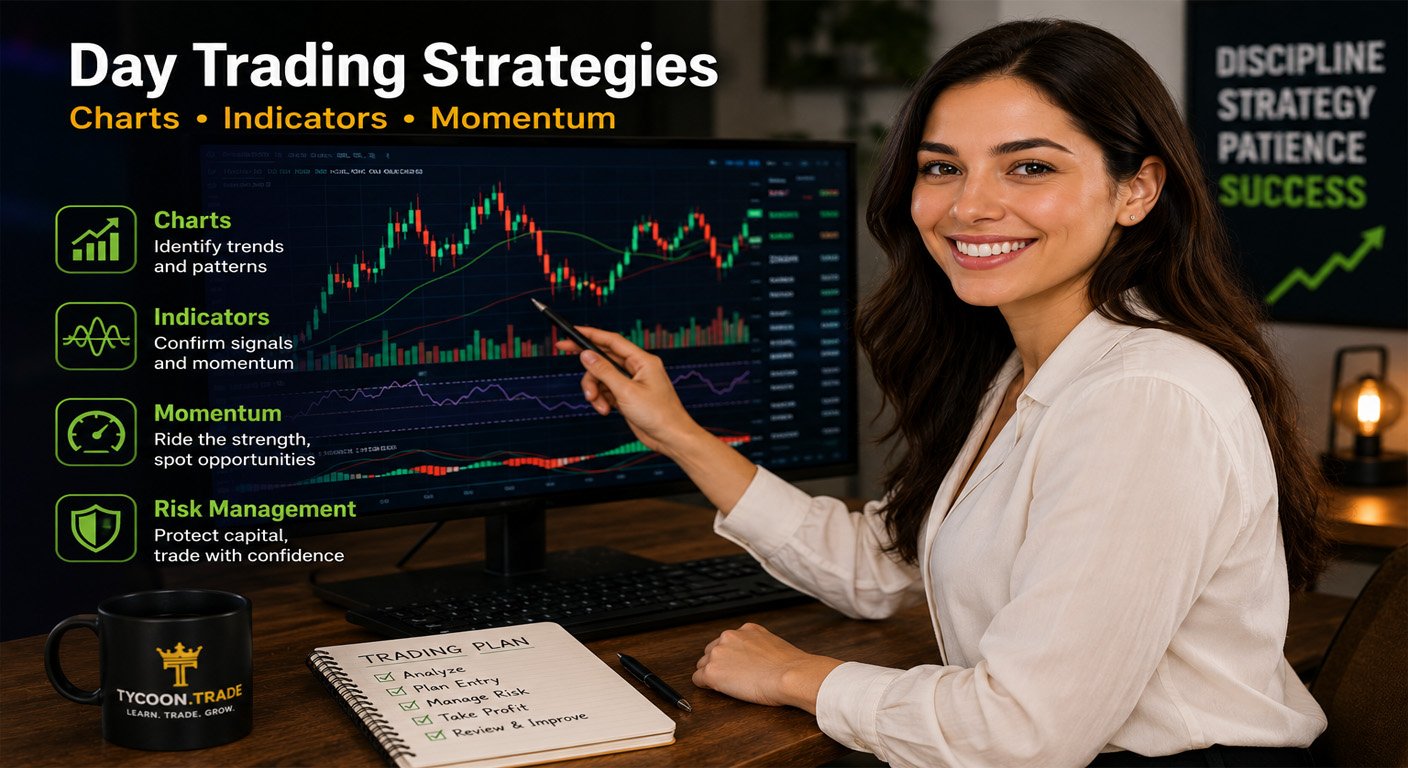
Day traders rely on fast decisions, clear setups, and disciplined risk management. While no chart or indicator can guarantee a winning trade, technical analysis can help traders identify potential opportunities, understand price behavior, and avoid random guessing.
Tycoon.Trade teaches that smart day trading is not about chasing every price move. It is about learning how charts, indicators, volume, and momentum work together so traders can make better-informed decisions.
What Is Day Trading?
Day trading is the process of buying and selling financial assets within the same trading day. Day traders may trade stocks, forex, crypto, ETFs, or other markets. The goal is usually to profit from short-term price movement.
Because day trading moves quickly, traders need a plan before entering the market. Without structure, beginners can easily make emotional decisions and lose money.
Why Charts Matter in Day Trading
Charts show how price has moved over time. They help traders identify trends, reversals, support levels, resistance levels, and possible breakout areas.
Common chart types include:
- Candlestick charts: Popular among traders because they show open, high, low, and close prices.
- Line charts: Simple charts that show price movement over time.
- Bar charts: Detailed charts that also show price ranges for each time period.
Understanding Candlesticks
Candlesticks help traders see buying and selling pressure. A strong green candle may show buyer strength, while a strong red candle may show seller pressure. Long wicks can suggest rejection or hesitation at certain price levels.
Beginners should not rely on one candle alone. Candlesticks are more useful when combined with trend, volume, support, resistance, and risk planning.
Support and Resistance
Support is an area where price has previously found buying interest. Resistance is an area where price has previously faced selling pressure.
Day traders often watch these areas because price may react near them. A breakout above resistance may suggest strength. A breakdown below support may suggest weakness.
How Indicators Help Traders
Trading indicators are tools that use price, volume, or mathematical formulas to help traders interpret market behavior. Indicators should not be treated as magic signals. They are best used as confirmation tools.
Moving Averages
Moving averages smooth price action and help traders identify the direction of a trend. If price stays above a moving average, traders may view the trend as stronger. If price falls below it, traders may watch for weakness.
Relative Strength Index
The Relative Strength Index, also known as RSI, helps traders evaluate whether an asset may be overbought or oversold. It can also help reveal momentum shifts.
MACD
The MACD indicator can help traders evaluate momentum and trend changes. Some traders use MACD crossovers or histogram changes as part of a broader strategy.
Volume
Volume shows how much trading activity is happening. Strong price movement with high volume may be more meaningful than price movement with low volume.
Momentum Trading Explained
Momentum trading focuses on assets that are moving strongly in one direction. Day traders may look for stocks, crypto, or forex pairs with unusual volume, strong news catalysts, or clear trend movement.
Momentum can create opportunity, but it can also reverse quickly. Traders should always know where they will exit before entering a momentum trade.
What Day Traders Look for Before Entering a Trade
A disciplined trader may look for several forms of confirmation before entering:
- Clear trend direction
- Support or resistance level
- Strong volume
- Momentum confirmation
- Defined stop-loss level
- Acceptable risk-to-reward ratio
Example of a Basic Day Trading Setup
A beginner-friendly example might look like this:
- Price is trending upward.
- Price pulls back near a support level.
- Volume increases as buyers return.
- A bullish candlestick forms.
- The trader sets a stop-loss below support.
- The trader only enters if the possible reward is greater than the risk.
This does not guarantee success, but it creates a structured decision instead of an emotional guess.
Common Mistakes with Charts and Indicators
Many beginners overload their charts with too many indicators. This can create confusion instead of clarity. Others enter trades because one indicator gives a signal, even when the broader market does not support the trade.
Common mistakes include:
- Using too many indicators
- Ignoring volume
- Trading without a stop-loss
- Entering after momentum is already fading
- Confusing a lucky trade with a strong strategy
- Ignoring risk-to-reward
Risk Management Still Comes First
Charts and indicators can help traders identify possible setups, but they do not remove risk. Every trade can lose money. That is why risk management should come before profit targets.
Smart day traders often use:
- Position sizing
- Stop-loss planning
- Daily loss limits
- Trade journaling
- Emotional discipline
How Tycoon.Trade Can Help Day Traders Learn
Tycoon.Trade can help beginners understand charts, indicators, and momentum through simple educational resources. The site can become a learning hub for traders who want clear explanations without unrealistic profit promises.
Helpful resources could include:
- Candlestick chart tutorials
- Indicator comparison guides
- Momentum trading lessons
- Support and resistance examples
- Trading journal templates
- Risk management worksheets
Final Thoughts
Day traders use charts, indicators, and momentum to make better decisions, but no tool guarantees a winning trade. The best traders combine technical analysis with patience, discipline, and strong risk control.
If you want to trade like a market tycoon, learn the tools, practice carefully, protect your capital, and never let emotion replace strategy.
Disclaimer: This article is for educational purposes only and is not financial, investment, tax, or legal advice. Day trading involves significant risk and can result in financial loss. Always do your own research and consult a qualified financial professional before making trading or investment decisions.
Tycoon Related Articles
Risk Management Secrets Every Profitable Trader Should Know
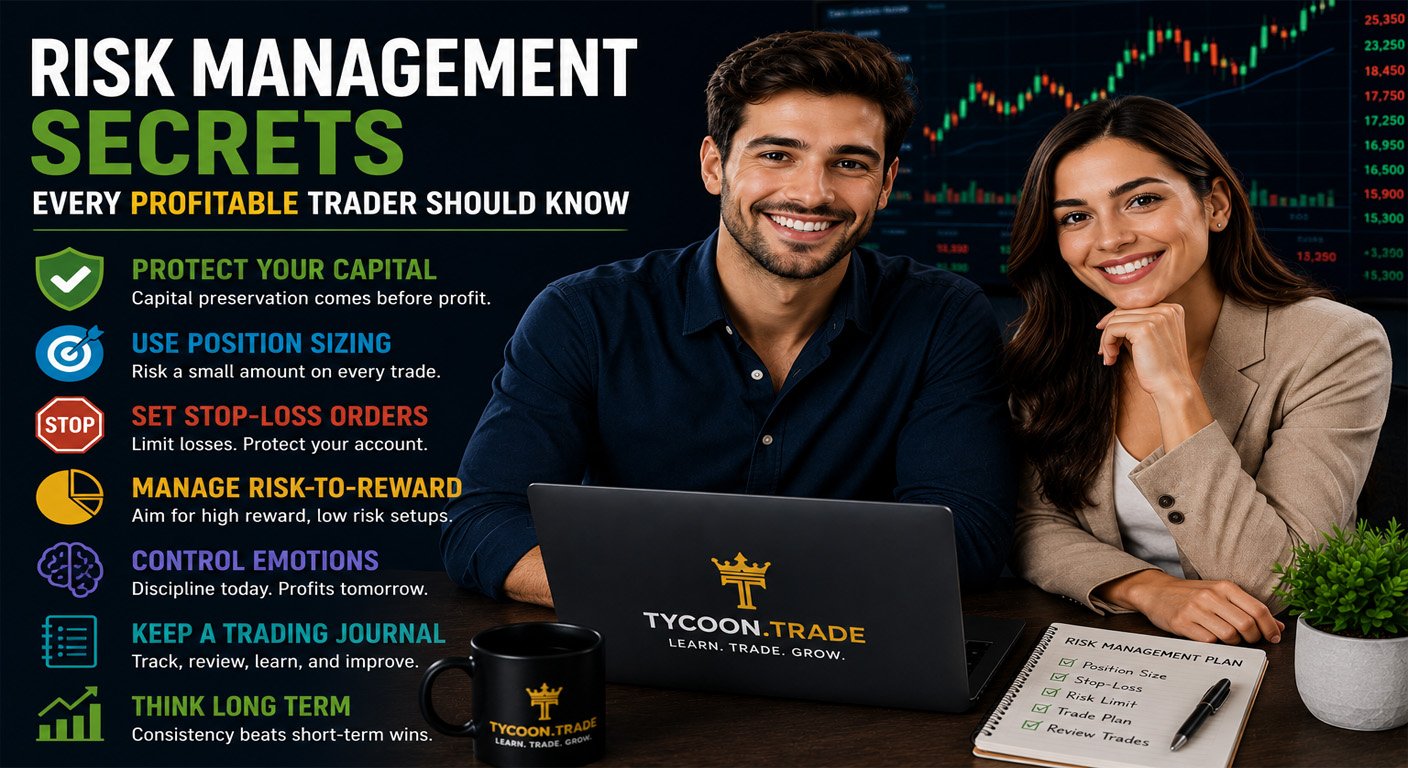
Most beginners enter the market asking, “How much money can I make?” Profitable traders ask a better question: “How much money can I afford to risk?”
Risk management is the foundation of long-term trading success. Without it, even a good strategy can fail. With it, traders can protect capital, survive losing streaks, and improve their skills over time.
Why Risk Management Matters More Than Predictions
No trader can predict every market move. Stocks, forex, crypto, and other markets can change quickly because of news, earnings reports, interest rates, global events, or investor emotion.
Because no setup is guaranteed, traders need rules that protect them when they are wrong. A trader does not need to win every trade to survive, but they do need to keep losses controlled.
Secret 1: Protect Your Trading Capital First
Your trading capital is your business inventory. Once it is gone, your ability to trade is gone too. Serious traders protect capital before chasing profit.
Smart capital protection habits include:
- Never trading money needed for bills or emergencies
- Starting small while learning
- Avoiding emotional position increases
- Keeping cash available instead of staying fully invested
- Reducing size during uncertain market conditions
Secret 2: Use Position Sizing
Position sizing means deciding how much money to place in each trade. A small position can protect you from a large mistake. An oversized position can turn one bad trade into a major financial setback.
Many traders use a fixed-risk approach, where they risk only a small percentage of their account on each trade. This helps prevent one trade from damaging the entire account.
Secret 3: Plan Your Stop-Loss Before Entering
A stop-loss is a planned exit point designed to limit losses. Beginners often enter trades first and think about risk later. Profitable traders do the opposite.
Before entering a trade, ask:
- Where is my invalidation point?
- How much can I lose if this trade fails?
- Does the possible reward justify the risk?
- Am I following my trading plan?
Secret 4: Avoid Over-Leverage
Leverage can make gains look exciting, but it can also magnify losses. Many beginners underestimate how quickly leveraged trades can move against them.
A profitable trader treats leverage with caution. The goal is not to take the biggest possible trade. The goal is to take a controlled trade that fits the plan.
Secret 5: Set a Daily Loss Limit
A daily loss limit protects traders from emotional spirals. After several losses, many traders become frustrated and try to win everything back. This is called revenge trading, and it can destroy accounts quickly.
A simple rule might be:
- Stop trading after a set dollar loss
- Stop trading after a set percentage loss
- Stop trading after three poor-quality trades
- Step away when emotional or distracted
Secret 6: Think in Probabilities
Trading is not about being right every time. It is about making decisions where the potential reward makes sense compared to the risk.
A trader can lose several trades and still be profitable over time if losses are small and winners are managed properly. This is why risk-to-reward planning matters.
Secret 7: Keep a Trading Journal
A trading journal turns experience into education. By tracking your trades, you can see whether your losses come from poor setups, emotional decisions, bad timing, or weak risk control.
Your journal should include:
- Trade date
- Market traded
- Entry and exit price
- Risk amount
- Reason for trade
- Result
- Lesson learned
Secret 8: Do Not Confuse Luck with Skill
A beginner may win several trades by chance and believe they have mastered the market. This can lead to overconfidence and oversized trades.
Profitable traders respect the market. They know one lucky trade does not prove a strategy works. Real skill is measured over many trades, different market conditions, and disciplined reviews.
How Tycoon.Trade Can Help Traders Manage Risk
Tycoon.Trade can become a powerful resource for traders by teaching capital protection, risk planning, and disciplined trading habits.
Helpful resources could include:
- Risk management calculators
- Position sizing worksheets
- Stop-loss planning guides
- Trading journal templates
- Beginner risk control lessons
- Trading psychology case studies
Final Thoughts
The traders who last are not always the traders with the flashiest strategies. They are often the traders who manage risk better than everyone else.
If you want to trade like a market tycoon, focus on survival first. Protect your capital. Control your losses. Follow your plan. Review your trades. Let discipline become your advantage.
Disclaimer: This article is for educational purposes only and is not financial, investment, tax, or legal advice. Trading stocks, crypto, forex, options, or other financial products involves risk, including possible loss of principal. Always do your own research and consult a qualified financial professional before making trading or investment decisions.
Tycoon Related Articles
The Psychology of Successful Traders: Habits Every Market Tycoon Must Learn

Successful trading is not only about charts, indicators, or market news. The real difference between a reckless beginner and a disciplined trader often comes down to trading psychology. Fear, greed, impatience, overconfidence, and revenge trading can destroy an account faster than a bad strategy.
Tycoon.Trade teaches that a true market tycoon does not trade on emotion. A successful trader builds habits, follows rules, manages risk, and thinks long term.
Why Trading Psychology Matters
Markets move fast. Prices rise and fall. News creates sudden reactions. Without emotional control, traders may panic, chase trades, hold losers too long, or risk too much after a winning streak.
Strong trading psychology helps traders:
- Stay calm during losses
- Avoid revenge trading
- Follow a written trading plan
- Accept that not every trade will win
- Protect capital before chasing profits
Case Study: From Emotional Trader to Disciplined Market Thinker
Consider this fictional but realistic case study of a beginner trader named Marcus.
Marcus started trading with excitement. He watched videos, followed online trading groups, and believed he could make quick daily profits. At first, he had a few winning trades and felt confident. But soon, he began taking larger positions, ignoring stop-losses, and chasing trades after losses.
The Problem
Marcus was not losing because he lacked access to trading tools. He was losing because he lacked discipline. His biggest mistakes included:
- Trading without a written plan
- Risking too much per trade
- Entering trades based on hype
- Holding losing trades too long
- Trying to win back losses immediately
The Turning Point
After several emotional losses, Marcus changed his approach. Instead of asking, “How much can I make today?” he started asking, “How can I trade better today?”
He created a simple trading plan, reduced his position size, tracked every trade, and stopped trading after reaching a daily loss limit.
The New Trading Habits
Marcus built a better routine:
- Review market conditions before trading
- Only take trades that match his plan
- Limit risk on every trade
- Stop trading when emotional
- Review wins and losses every week
His results did not become perfect overnight, but his decision-making improved. He became less emotional, more patient, and more consistent.
Habit 1: Create a Written Trading Plan
A trading plan gives structure to your decisions. It should explain what you trade, when you trade, why you enter, when you exit, and how much you are willing to risk.
Habit 2: Manage Risk Before Profit
Successful traders know that protecting capital is the first priority. A trader who survives can keep learning. A trader who risks too much may not get a second chance.
Habit 3: Accept Losses as Part of Trading
No trader wins every trade. Losses are part of the process. The goal is not to avoid every loss. The goal is to keep losses controlled and learn from them.
Habit 4: Avoid Revenge Trading
Revenge trading happens when a trader tries to quickly win back money after a loss. This often leads to poor decisions and larger losses. A disciplined trader steps away when emotions are high.
Habit 5: Keep a Trading Journal
A trading journal helps traders understand their behavior. It can reveal whether losses come from bad entries, poor exits, emotional decisions, or weak risk management.
How Tycoon.Trade Can Help Traders Build Discipline
Tycoon.Trade can help traders improve by offering practical education focused on mindset, risk control, and repeatable habits.
Helpful resources could include:
- Trading psychology lessons
- Risk management checklists
- Trading journal templates
- Emotional control guides
- Case studies of beginner mistakes
- Weekly trading review worksheets
Final Thoughts
The psychology of successful traders is built through discipline, patience, self-awareness, and risk control. Tools and charts matter, but mindset often determines whether a trader survives long enough to improve.
To trade like a market tycoon, do not chase every opportunity. Build habits. Follow your plan. Review your mistakes. Protect your capital. Think long term.
Disclaimer: This article is for educational purposes only and is not financial, investment, tax, or legal advice. Trading stocks, crypto, forex, options, or other financial products involves risk, including possible loss of principal. Always do your own research and consult a qualified financial professional before making investment decisions.
Tycoon Related Articles